
COLOUR IN CONTEXT
The same colour looks completely different depending on what’s around it. Colour is a shape-shifter — and context is its trigger.
CORE CONCEPT
IMPORTANCE OF COLOUR IN CONTEXT
KEY KNOWLEDGE
1
The same colour looks different depending on the colours around it — context changes perception
REAL WORLD EXAMPLE
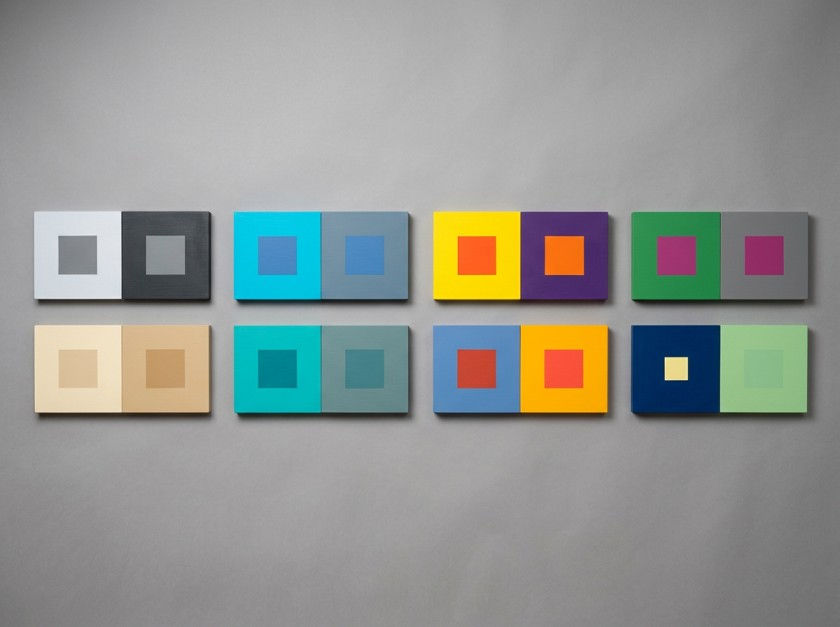
Go to a paint store and pick up a grey swatch. Hold it against a white wall — it looks dark, almost charcoal. Now hold the same swatch against a black wall — it looks light, almost silver. It's the identical grey. Your eyes haven't changed. But your brain is comparing the grey to what's around it, and that comparison changes your perception. This is why paint stores always tell you: "Take the swatch home and hold it against your actual wall." A grey that looks perfect in the bright white store can look completely different in your warm-toned bedroom.
2
Simultaneous contrast: neighbouring colours influence how we perceive a colour’s hue, value, and saturation
REAL WORLD EXAMPLE
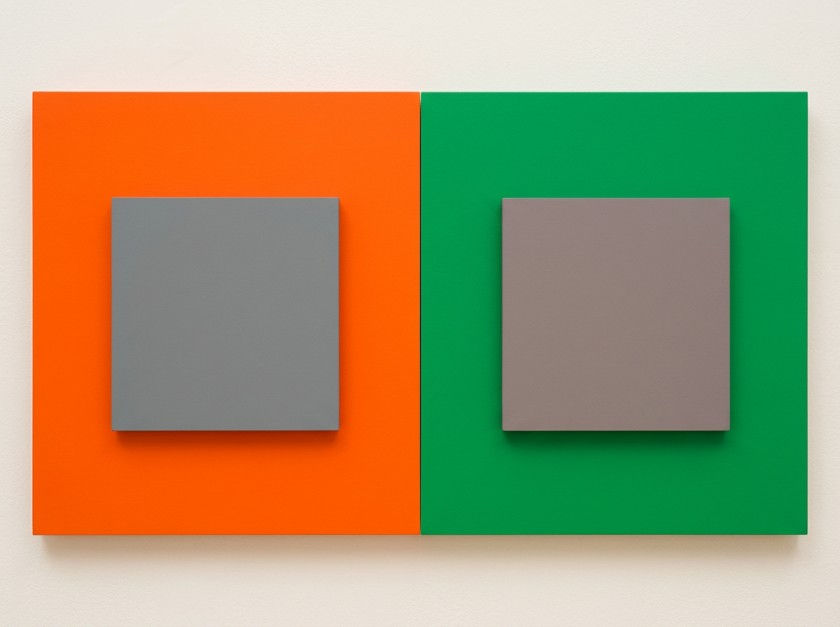
Place a medium grey square on a bright orange background. The grey takes on a slight blue tinge — your brain adds blue to "balance" the orange. Place the same grey on a green background, and it picks up a slight red tinge. The grey hasn't changed at all — but your visual system is playing tricks, pushing the grey toward the complement of its surrounding colour. This is simultaneous contrast, discovered by Michel Chevreul in the 1830s — and it's the reason fabric weavers, painters, and designers have been obsessing over colour neighbours for centuries.
3
A colour looks lighter on a dark background and darker on a light background

REAL WORLD EXAMPLE
Open any app on your phone in light mode and dark mode. Look at the same icon in both. In light mode (white background), the icon colour looks punchy and dark. In dark mode (black background), the same icon colour seems to glow and feel lighter. This isn't a different colour — it's the same hex code. But the background is changing your perception of its brightness. Interior designers know this instinctively: a medium brown wooden floor looks warm and light in a dark-walled room, but looks heavy and muddy in a white-walled room. Context is king.
4
A colour looks more saturated when surrounded by its complement and more muted when surrounded by similar colours

REAL WORLD EXAMPLE
Place a red cushion on a green sofa — the red looks electric, vibrant, almost glowing. That's because green (red's complement) pushes the red to appear at maximum saturation. Now place the same red cushion on an orange sofa — the red looks duller, less vivid, almost brownish. The orange (a similar warm colour) pulls the red's perceived saturation down. This is why complementary colour schemes feel so energetic and analogous ones feel calm — complements amplify each other's intensity, while similar colours mute each other.
5
Warm colours look warmer next to cool colours, and vice versa — contrast amplifies temperature
REAL WORLD EXAMPLE
A warm amber candle sitting on a warm brown wooden table looks nice — warm, but not dramatically so. Move that same candle onto a cool slate-grey surface and suddenly it GLOWS. The amber looks ten times warmer because the cool grey is amplifying its warmth through contrast. It works both ways: a cool blue glass on a warm orange tray looks extra icy and refreshing. Stylists know this — that's why food photography of cold drinks almost always uses warm backgrounds. The contrast makes the drink look colder.

6
This is why designers never choose colours in isolation — they always test in context
REAL WORLD EXAMPLE
A junior designer picks a gorgeous teal for a website header. It looks beautiful on the swatch. They build the page, and the teal header sits on top of a pale green content section. Suddenly the teal looks muddy and grey — the neighbouring green drained its vibrancy. Their mentor says: "Never fall in love with a colour on a swatch. Fall in love with it on the page." Context changes everything. That's why professional tools like Figma and Canva show your colours in the actual layout, not on a separate palette screen. The layout is the truth. The swatch is just a promise.

7
Background colour dramatically affects readability: dark text on light backgrounds is easiest to read on screen; the wrong combination can make content illegible

REAL WORLD EXAMPLE
Try this: type a sentence in medium blue on a white background. Perfectly readable. Now type the same sentence in medium blue on a dark purple background. Nearly invisible. Now type yellow text on a white background. You can barely see it. The science is simple: readability depends on value contrast between text and background. Dark on light = maximum contrast = easy reading. Light on light or dark on dark = low contrast = frustration. This is why every newspaper, every textbook, and every major app uses dark text on light backgrounds for body content. It's not a design choice — it's a readability requirement.
8
Colour context applies everywhere: screens, print, physical spaces, clothing, packaging — every colour is surrounded by other colours

REAL WORLD EXAMPLE
A clothing designer creates a beautiful turquoise kurta. In the studio, against a white mannequin and neutral walls, it looks stunning. At the store, it's hung between a neon pink top and a bright orange dupatta — and suddenly it looks washed out and dull. Same garment. Same turquoise. But the retail context changed how it looks. That's why luxury stores hang garments with space between them (so each colour breathes) and fast fashion stores pack racks tight (so the chaos creates energy). Every colour you see — on screen, in print, on your body, on a shelf — is being modified by its neighbours.
Pro Connection
Graphic designers say “it looked different on the swatch card” — because swatches lack context. UI designers do “colour accessibility testing” to ensure colour choices work in their actual screen environment. Interior designers always view paint samples ON the wall, never just the chip. The professional lesson is: never trust a colour until you’ve seen it in context.
PROFESSIONAL TERMINOLOGY
CLICK TO REVEAL and CLICK TO COVER
The phenomenon where adjacent colours change how each other is perceived
What is
SIMULTANEOUS CONTRAST
The surrounding colours and environment that influence how a specific colour appears and feels
What is
COLOUR CONTEXT
The way colours affect each other when placed side by side — each changes how the other is perceived
What is
COLOUR INTERACTION
When your brain interprets colour differently from its actual physical properties because of surrounding context
What is
OPTICAL ILLUSION
Evaluating colour choices in the actual context where they'll be used, not in isolation
What is
COLOUR TESTING
TINT-SHADE-TONE HUNT
You've been surrounded by tints, shades, and tones your entire life — you just didn't have the names for them. Today that changes.
what TO DO
Pick ONE colour — any colour you like.
Find 3 versions of that colour in your surroundings or on your phone.
TINT: a lighter, softer version (more white added) — e.g. pale sky blue if your colour is blue.
SHADE: a darker, deeper version (more black added) — e.g. navy if your colour is blue.
TONE: a muted, greyed version (grey added) — e.g. slate blue or dusty blue.
Photograph or screenshot all three. Label each one clearly.
CHALLENGE
DISCOVERY
You can use these SOFTWARES for this Discovery Challenge
FREE SOFTWARE : Canva, PicsArt, Phone Photos Editor with Markup, Google Keep
PAID SOFTWARE : Canva Pro, Procreate Pocket