
LEADING LINES - GUIDING THE EYE
What if there are invisible paths inside every great image — roads, shadows, edges, rows of objects — that pull your eye on a journey?
CORE CONCEPT
IMPORTANCE OF LEADING LINES
KEY KNOWLEDGE
1
Leading lines are elements within a composition that direct the viewer’s eye along a path

REAL WORLD EXAMPLE
Stand at one end of your school corridor and look straight ahead. The floor tiles, the walls on both sides, the ceiling — they all rush toward the end like arrows pointing to one spot. Your eye didn't choose to travel there. The lines pulled it. That's exactly what a photographer, filmmaker, or designer does — they find lines that already exist in a scene and use them to drag your eye exactly where they want it to go.
2
They can be literal (a road, fence, staircase) or implied (a row of objects, a shadow, a person’s gaze)

REAL WORLD EXAMPLE
A railway track is an obvious leading line — you can literally see where it takes your eye. But here's a subtler one: three students sitting on a bench, all looking to the right. Your eye follows their gaze even though there's no actual line drawn anywhere. Their attention becomes the line. Leading lines don't always need to be painted on the ground — sometimes a glance, a shadow, or a row of parked cycles does the same job invisibly.
3
Converging lines (meeting in the distance) create powerful depth

REAL WORLD EXAMPLE
Stand in the middle of any Indian road that runs straight for a long stretch — the edges of the road, the electricity poles on both sides, even the painted lane markings — they all appear to meet at one tiny point far away. In reality, the road isn't getting narrower. But your brain reads those converging lines as depth — the feeling that you could walk into the image. That's why travel photos shot on long roads feel so dramatic — the lines are doing the storytelling.
4
Diagonal lines create energy and movement. Curved lines create gentle flow

REAL WORLD EXAMPLE
Think of a staircase in a fort — the kind that zigzags sharply up a stone wall. It feels adventurous, full of energy, like something is about to happen at the top. Now think of the curved ramp at a hospital entrance — smooth, slow, gently guiding you without any sudden turns. Both are lines. But the diagonal says "let's go!" while the curve says "take your time." Designers choose between these two feelings every day.
5
Horizontal lines suggest calm. Vertical lines suggest strength
REAL WORLD EXAMPLE
Picture a sunset at a beach — the horizon line cuts straight across, the water is flat, the sky is wide. Everything feels peaceful. Now picture a row of tall coconut trees standing upright against that same sky. Suddenly there's a feeling of height, of standing firm, of strength. The horizon calmed you down. The verticals woke you up. Two types of lines, two completely different moods — in the exact same scene.

6
The best leading lines point toward the focal point, reinforcing where to look
REAL WORLD EXAMPLE
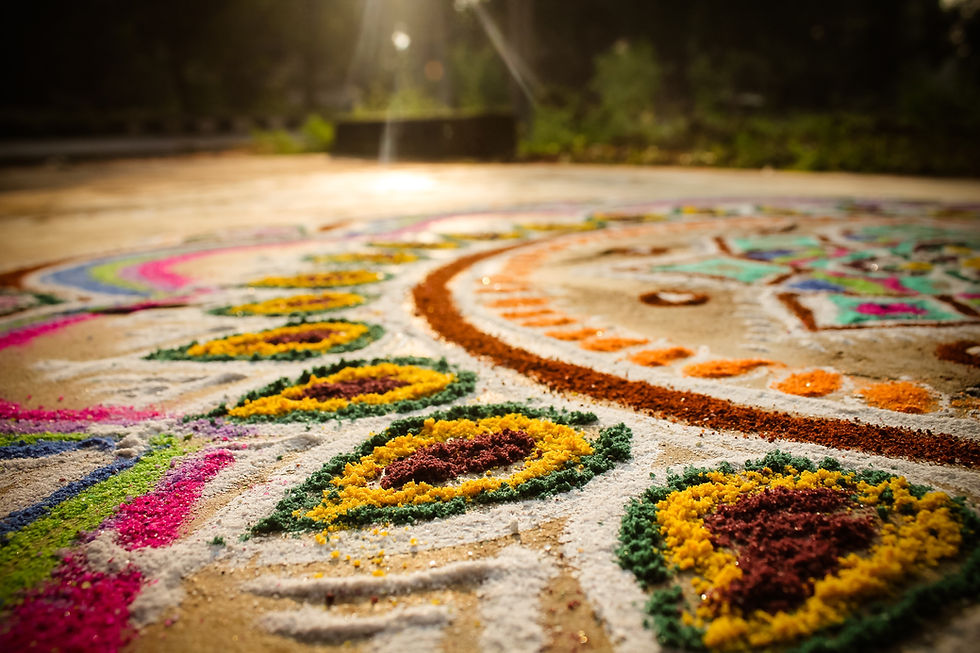
Think of a rangoli made during a festival outside a main door. The patterns don't just sit there — the petals, the curves, the lines of powder all radiate toward the centre, where the diya or the main design sits. Your eye follows the lines inward like a map leading to treasure. That's the principle: the best lines in any composition aren't just decorative — they're arrows that say "look here, this is what matters."
7
In architecture and spatial design, leading lines are literal pathways guiding people through spaces

REAL WORLD EXAMPLE
Next time you visit a mall, notice the floor. The tiles aren't random — there's usually a pattern or a change in colour that leads you from the entrance toward the escalator, then toward the food court. You think you're wandering freely, but you're actually walking on a designed path. Temples do the same thing — the stone pathway from the gate leads your feet (and your eyes) straight to the inner sanctum. Architecture uses leading lines not just for your eyes — but for your entire body.
8
What if every photo you love has a hidden line pulling your eye through it — and you just never noticed before?

REAL WORLD EXAMPLE
Go back to that one photo in your camera roll — the one you saved, maybe even set as your wallpaper. Now look again, slowly. There's probably a line hiding in it: the edge of a building, a crack in the ground, a rope, a shadow, the curve of someone's arm. That line is the reason the photo works — it's what moved your eye from one part of the image to another and made you feel something. The line was always there. Now you can finally see it.
Pro Connection
Cinematographers talk about “using the architecture to lead the eye.” Photographers say “I used the road as a leading line.” Environmental designers plan visitor journeys using physical pathways. UI designers call this “visual flow.” Same principle, different scales.
PROFESSIONAL TERMINOLOGY
CLICK TO REVEAL and CLICK TO COVER
Lines within a composition that guide the viewer's eye toward a subject or through the image
What is
LEADING LINES
Lines that come together toward a single point, creating powerful depth
What is
CONVERGING LINES
The point in the distance where converging lines appear to meet
What is
VANISHING POINT
A line running at an angle — creates energy and movement
What is
DIAGONAL
The illusion of three-dimensional space in a two-dimensional image
What is
DEPTH
THE OFF-CENTRE EXPERIMENT
What if the most interesting place for your subject... is not the middle?
what TO DO
Turn on the grid in your phone camera: Settings > Camera > Grid.
Choose anything to photograph — a cup, a plant, a friend, anything you like.
Take TWO photos of the same thing: Photo A — put the subject RIGHT IN THE MIDDLE of the frame. Photo B — move it so it sits on one of the lines or corner points of the grid.
Look at both photos. Which one do you prefer? Show both to a friend — which one do THEY prefer?
CHALLENGE
DISCOVERY
You can use these SOFTWARES for this Discovery Challenge
FREE SOFTWARE : Phone Camera, Snapseed, VSCO, Adobe Lightroom Mobile
PAID SOFTWARE : VSCO Membership, Adobe Lightroom Premium